Monday, July 29, 2013
Green Energy launches new tariff


Friday, July 26, 2013
£20,000,000 Green Deal fund
The fund, announced on 25 July, will support local authorities, in partnership with local community organisations and businesses, to encourage take-up of the Green Deal in whole streets and areas throughout the country.
The government also confirmed that a £200mn energy efficiency scheme for homes in the north-east––Warm Up North––has been announced by Newcastle City Council. Up to 50,000 households and businesses in the north-east are set to benefit.
Thursday, July 25, 2013
News story: Green Deal Communities
Updated: Latest figures published.
Update 19 December 2013
To date we have received 40 Green Deal Communities' bids which we're are considering. We hope to announce the first successful Green Deal Communities bids in the new year.
Please see “Available funding” paragraph below regarding a change to the amount of funding available
DECC is inviting local authorities (LAs), working with their partners, to come forward with ambitious and innovative street/area based proposals for funding. These proposal should aim to deliver Green Deal plans to as many households as possible. DECC funding can also be used to support households who choose to self-finance measures.
Proposals will be judged on:
- the number and total value of Green Deal plans that will be delivered
- their credibility eg LAs will need to demonstrate that they have secured Energy Companies Obligation (ECO) funding to compliment Green Deal financed plans and to have specifically identified the streets/areas targeted
- their creativity in offering local incentives to drive demand
- their sustainability in the long term (ie beyond the DECC funding) and
- being consistent with state aid and procurement rules
Available funding
Following the announcement on 2 December 2013, there is now £80 million of capital funding available. Applications may be submitted at any time from September 2013 up to 31 December 2013 for a minimum of £1 million. LAs will be strongly encouraged to work together and with local partners to deliver.
What DECC might fund
Within the parameters above, LAs will have flexibility in how to deliver Green Deal plans with this capital funding. We would expect the following to be included:
- proposals to deliver solid wall insulation to private households with a strong blend of Green Deal finance/ECO subsidy
- a comprehensive offer to as many households as possible: some households in a street may fund measures by blending Green Deal finance and ECO, some may choose to self-fund measures, while others may be eligible for 100% ECO subsidy
- creative approaches eg local incentives, working with local community partners, or refunding Green Deal assessments where a household installs measures using Green Deal financing or self-finance
- show homes to launch activity in an area, and
- proposals that deliver long term public value eg plans/templates for how to retrofit local home types
Webchat: Applications for the Green Deal Communities Fund
DECC officials led a live webchat on the Green Deal Communities fund on Thursday 12 September answering a range of questions on:
- the fund scope
- eligibility
- and the application and assessment process
You can view a replay of the webchat on the DECC website.
Further information
Green Deal Communities application pack
(PDF, 116KB, 18 pages)
Green Deal Communities application pack
(MS Word Document, 139KB)- Local authorities and the Green Deal
We remind you that all bids must comply with State aid rules (including in the context of all other Government schemes and aid) and we will only be able to approve bids which meet this requirement.
You can find detailed guidance on State aid on the GOV.UK State Aid pages. We strongly recommend seeking legal advice to ensure your bid is State aid compliant.
Photo above by Alex Pepperhill on Flickr. Used under Creative Commons
Wednesday, July 24, 2013
Statistical data set: Sub-regional Feed-in Tariffs statistics
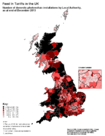
Updated: Latest tables and maps published.
Quarterly sub-regional statistics show the number of installations and total installed capacity by technology type in England, Scotland and Wales at the end the latest quarter that have been confirmed on the Central Feed-in Tariff Register.
Latest data is up to the end of December 2013.
Sub-regional Feed-in Tariffs confirmed on the CFR statistics
MS Excel Spreadsheet, 750KB
This file may not be suitable for users of assistive technology.
Request a different format.
If you use assistive technology and need a version of this document
in a more accessible format please email
correspondence@decc.gsi.gov.uk
quoting your address, telephone number along with the title of the
publication ("Sub-regional Feed-in Tariffs confirmed on the CFR statistics").
Number of domestic photovoltaic installations per local authority: map
PDF, 383KB, 1 page
This file may not be suitable for users of assistive technology.
Request a different format.
If you use assistive technology and need a version of this document
in a more accessible format please email
correspondence@decc.gsi.gov.uk
quoting your address, telephone number along with the title of the
publication ("Number of domestic photovoltaic installations per local authority: map").
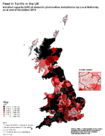
Installed Capacity (kW) of domestic photovoltaic installations by Local Authority
PDF, 378KB, 1 page
This file may not be suitable for users of assistive technology.
Request a different format.
If you use assistive technology and need a version of this document
in a more accessible format please email
correspondence@decc.gsi.gov.uk
quoting your address, telephone number along with the title of the
publication ("Installed Capacity (kW) of domestic photovoltaic installations by Local Authority").
Press enquiries should be directed to the DECC press office: Tel: 0300 068 5223.
For enquiries concerning these tables either email fitstatistics@decc.gsi.gov.uk or contact:
Mita Kerai: 0300 068 5044
Ed Franklyn: 0300 068 5789
James Hemingway: 0300 068 5042
Statistical data set: Monthly central Feed-in Tariff register statistics

Updated: Latest table published.
Statistics presented in the monthly table below show the number of installations and capacity installed by technology type and tariff band that are confirmed on the Central Feed-in tariff Register (CFR) and eligible for FiT payments.
Monthly central Feed-in Tariff register statistics
MS Excel Spreadsheet, 434KB
This file may not be suitable for users of assistive technology.
Request a different format.
If you use assistive technology and need a version of this document
in a more accessible format please email
correspondence@decc.gsi.gov.uk
quoting your address, telephone number along with the title of the
publication ("Monthly central Feed-in Tariff register statistics").
Press enquiries should be directed to the DECC press office: Tel: 0300 068 5223.
For enquiries concerning these tables email fitstatistics@decc.gsi.gov.uk or contact:
Mita Kerai
Tel: 0300 068 5044
Ed Franklyn
Tel: 0300 068 5789
James Hemingway
Tel: 0300 068 5042
Statistical data set: Monthly MCS and ROOFiT statistics
Updated: Latest table published.
The MCS and ROOFiT pipeline statistics show the number of installations each month that are registered on the Microgeneration Certification Scheme - MCS Installation Database and the number of installations with a total installed capacity accredited through the ROOFiT scheme.
Monthly MCS and ROOFiT statistics
MS Excel Spreadsheet, 200KB
This file may not be suitable for users of assistive technology.
Request a different format.
If you use assistive technology and need a version of this document
in a more accessible format please email
correspondence@decc.gsi.gov.uk
quoting your address, telephone number along with the title of the
publication ("Monthly MCS and ROOFiT statistics").
Press enquiries should be directed to the DECC press office: Tel: 0300 068 5223.
For enquiries concerning these tables either email fitstatistics@decc.gsi.gov.uk or contact:
Mita Kerai
Tel: 0300 068 5044
Ed Franklyn
Tel: 0300 068 5789
James Hemingway
Tel: 0300 068 5042
Consultation outcome: Updates to the Electricity and Gas (Energy Companies Obligation) Order 2012
Updated: The government response has been published today.
This consultation seeks views on a small number of technical amendments to the Electricity and Gas (Energy Companies Obligation) Order 2012. The amendments are designed to ensure the ECO Order is aligned with changes in the broader policy landscape, and to provide greater clarity on certain aspects of the Scheme to aid its continued smooth delivery.
Source: Consultation outcome: Updates to the Electricity and Gas (Energy Companies Obligation) Order 2012
Friday, July 19, 2013
Measuring and Reporting Environmental Impact
- From the 1st October 2013 the 'Companies Act 2006 (Strategic & Directors Report) Regulations 2013' will require all UK quoted companies to report on their greenhouse gas emissions as part of their annual directors report.
- This affects all UK incorporated companies listed on: the main market of the London Stock Exchange, a European Economic area market of whose shares are dealing on the New York Stock Exchange or NASDAQ.
There is a newly structured annual report being created with a section called 'The Strategic Report', within this, companies will be required to report on environmental matters.
Where appropriate the use of Key Performance Indicator's will also have to be reported; if the annual report does not include this information, then it must point out omissions.
Useful Terminology...
- Greenhouse Gasses - carbon dioxide, nitrous oxide, hydroflurocarbons, perflurocarbons and sulphur hexafluroide. Carbon dioxide is expected to be responsible for 2/3rd's of the anticipated future global warming
- Carbon Footprint - the total amount of greenhouse gas emissions caused by an organisation, product, event or person
- Climate Change - rising global temperatures bringing changes in weather, rising sea levels and increased frequency and intensity of extreme weather caused by the release of greenhouse gasses.
Benefits of Reporting...
- Provides Increased visibility into an organisations energy consumption - making it easier to budget and target energy use and costs
- Benefit from lower energy and resource costs
- Gain a deeper understanding of exposure to the risks of climate change
- Demonstrates organisations leadership and responsibility, which will strengthen green credentials in the marketplace
Using environmental KPI's can be helpful in capturing the link between environmental and financial performance
Thursday, July 18, 2013
British Gas launches new tariff
Ecotricity set to launch 100% green energy tariff
Wednesday, July 17, 2013
British Gas scrap rollover contracts - good news for all SME customers
A new process for renewing the contracts of existing customers – without an auto-rollover – will begin in June 2014
British Gas is the first energy supplier to commit to ending auto-rollover contracts, and the company is calling on other suppliers to follow suit.
Products without auto-rollover will be launched in September 2013 for new customers.
From June 2014, existing British Gas customers will be offered renewal options that require the customer to make a choice about which tariff they would like to sign up to, and which will not include another automatic fixed-term contract. Customers will be able to choose from a range of fixed-term or variable options.
Existing customers who reach the end of their contracts before June 2014 will be able to move to a non-rollover contract if they contact British Gas to discuss their renewal.
Stephen Beynon, Managing Director of British Gas Business, said: “At British Gas, we are committed to leading the way in making the sale of energy simple and transparent for all our customers. Increasing numbers of our small business customers have told us they don’t like the way the energy industry automatically moves them onto new contracts, so we’ve decided we will lead the way and put an end to this practice for our customers.
“We’re the first supplier to announce an end to auto-rollover contracts and we're calling on the industry and the regulator to work together to ensure that all customers have a transparent choice of products that never include auto-rollover."
Prime Minister David Cameron said: “Small businesses are the engine of our economy and I am committed to ensuring that we do everything we can to help them succeed. Whether that is support to grow, cutting red tape or the lowest energy bills, we have to do everything possible to provide the environment in which they can flourish.
“Last year I committed to ensuring that consumers get the best possible tariff from their supplier. I know that auto-rollovers have similarly been a big issue facing small business so two months ago, I set up a cross-industry group on this issue. I am therefore delighted to welcome British Gas’s leadership and I hope that other suppliers will rapidly follow suit.”
We hope that helps you if you have a renewal in the next few months and that this will give you more freedom to shop around!
Historic Electricity Price Data
Price shown are a standard index, industrial peak, peak and off peak. An interesting way to see the level of volatility on the UK electricity markets.
http://www.energybrokers.co.uk/electricity/historic-price-data-graph.htm
Tuesday, July 16, 2013
E.ON launches tariff updates
Monday, July 15, 2013
Efficient lighting is the most popular way of investing in green technology
More than three-quarters of respondents (77 per cent) said they had invested in energy efficient lighting in the past year. Next was employee awareness training (59 per cent), and energy metering, monitoring and targeting technology (57 per cent). Boilers and boiler controls was the next most popular, followed by efficient ventilation and air conditioning. Less popular was investment in compressed air and industrial processes.
See more at: http://www.fm-world.co.uk/news/business-news/lighting-tops-green-investment/
Wednesday, July 10, 2013
iSupply launches new tariff
Monday, July 08, 2013
TPI Regulations considered
The regulator expects the importance of TPIs in the GB retail energy market to increase given the introduction of smart meters and grids, along with increasing focus on energy efficiency. But following concerns over the practices of TPIs across the retail market, Ofgem is considering a spectrum of options for the development of a new overarching regulatory framework.
Options range from non-binding guidance on the regulator's expectations for TPI interactions with consumers to direct regulation of TPIs. The regulator's current view is that the definition of TPIs should not include charitable organisations, advice agencies and not for profit organisations such as Consumer Futures and Citizens Advice Consumer Service.
Thursday, July 04, 2013
July Update
Energy and Environment Ministers from twelve EU member states have today re-issued a joint statement calling for MEPs to support backloading proposals for the EU Emissions Trading System (EU ETS), due to be voted on in Strasbourg on Wednesday.
UK not expected to hit 2020 renewables target
The UK is not on track to meet its 2020 European renewables targets, according to the European Renewable Energy Council (EREC).
Government must adopt RHI 'lock in' mechanism says industry
Two industry groups have called on the Government to change budgeting rules for the renewable heat incentive (RHI), to increase investor certainty and unlock hundreds of millions of pounds of funding.
UK region reaches 1GW renewable energy milestone
The total capacity of renewable electricity in the south west has grown from 714MW in 2012 to more than 1 GW, according to a report released today.
Climate change opportunities could outweigh risks for UK businesses
Defra has set out the risks and opportunities businesses face as climate change and extreme weather becomes increasingly prominent.
Wednesday, July 03, 2013
Transparency data: DECC Business Plan: quarterly data summary - indicators and other data sets
Updated: Latest data summary published.
The Business Plan Quarterly Data Summaries (QDS) provide the latest data on indicators included in Departmental Business Plans as well as other published data and management information.