Tuesday, January 22, 2013

Detailed guide: Innovation funding for low-carbon technologies: opportunities for bidders

By HM Government

Updated: An update on a £13m funding programme for collaborative R&D and feasibility study projects, to stimulate innovation and strengthen the UK's civil nuclear supply chain.

Overview


This guide explains how to apply for competitions and schemes that form part of this drive for innovation. It also includes briefing documents and timetables.


We have committed over £200 million of funding for low-carbon technologies for 2011 to 2015. Details of how the funding has been allocated are shown at the end of the guide.


NER300 - EU Funding Mechanism for Renewables Demonstration Projects: Second call for proposals now open


On 3 April 2013, the European Commission published its Call for Proposals for the second round of New Entrant Reserve (NER) funding. The NER300 is a common fund of 300 million EU ETS allowances set aside for supporting about 8 CCS and 34 renewable energy projects. DECC has put together new guidance for potential UK applicants for renewable demonstration projects.


  • Further details are available from the European Commission website

  • For information on how to apply, read DECC's NER guidance

Application forms must be submitted to DECC electronically by 5pm on 20 June 2013, to innovation@decc.gsi.gov.uk


Bioenergy: funding schemes


Bioenergy demonstrator funding opportunity


The Department of Energy & Climate Change (DECC), BBSRC and the Technology Strategy Board are part of a European consortium that, supported by the European Commission, aims to encourage generation of bioenergy through a single collaborative funding call. The objective of the call is to fund several collaborative bioenergy demonstration projects.


A consortium of 8 EU member states and associated countries, including the UK, Denmark, Finland, Germany, Portugal, Spain, Sweden and Switzerland, is implementing BESTF, an Eranet-Plus activity. This activity will provide funding and support to collaborative bioenergy projects that demonstrate one or more innovative steps resulting in demonstration at a pre-commercial stage.


The competition is expected to launch in January 2013. Full details can be found on the Technology strategy Board website


Second EU Bioenergy Demonstrator funding opportunity


Following the successful implementation of the first EU ERANET plus bioenergy demonstrator joint call that closed in March 2013, The Department of Energy & Climate Change (DECC), Biotechnology and Biological Sciences Research Council (BBSRC) and the Technology Strategy Board (TSB) have joined forces again to lead a second initiative.


Bioenergy Sustaining the Future 2 (BESTF2), like its predecessor, aims to encourage the commercialisation of innovative bioenergy projects by providing financial support to high quality collaborative bioenergy demonstration projects.


Participating countries this time include the UK, Germany, Spain, Sweden, Switzerland, Denmark and The Netherlands. Projects will need to demonstrate active participation from at least two of these countries.


The BESTF2 joint call launched on 11 December 2013, and full details, including application forms, can be found on the BESTF website.


Video footage of the UK launch event can be found on the on the Environmental Sustainability Knowledge Transfer Network You Tube channel.


A Linked In group is available to facilitate communication between prospective partners.


Bioenergy Sustaining the Future 2: early market engagement document


PDF, 251KB, 5 pages


This file may not be suitable for users of assistive technology.
Request a different format.


If you use assistive technology and need a version of this document
in a more accessible format please email
correspondence@decc.gsi.gov.uk
quoting your address, telephone number along with the title of the
publication ("Bioenergy Sustaining the Future 2: early market engagement document ").


Energy efficiency and storage: funding schemes


Heat storage competition for SBRI contracts


DECC launched a competition to assess the performance of advanced thermal storage, which can be integrated with heat technologies to help balance peak loads to the grid.


The competition aims to assess the viability of compact heat storage materials as an effective means to mitigate potential strain on the electricity grid in scenarios of increasing loads from low-carbon heat technologies (such as heat pumps).


The competition closed to applicants in August 2012. Successful studies are to be invited to participate in a prototype demonstration (Phase 2) in spring 2013, with monitoring to take place over a 12-month period.


Competition timeline for 2013 to 2014


Milestone
Date
Successful Phase 1 reports invited to tender
Jan 2013
Deadline for Phase 2 applications
Feb/Mar 2013
Phase 2 delivery commences
March 2013
Phase 2 monitoring stage
1 April 2013 to 28 Mar 2014

Competition documents


DECC advanced heat storage project brief


Advanced heat storage competition guidance notes


DECC Pre-Commercial Procurement contract template
(PDF, 105KB, 21 pages)


Further information


For information about the competition scope and applications please email heatstorage@decc.gsi.gov.uk


Training and skills: funding schemes


Funding of energy efficiency training (non-domestic) competition


DECC organised a competition to boost training to enhance energy efficiency skills among individuals with responsibility for energy usage in non-domestic premises.


Training providers were able to apply for a share of the £100,000 available. The deadline for proposals was 5pm on 4 January 2013.


Bids will be judged separately against a range of criteria including value for money, deliverability and the overall fit with DECC's strategic priorities. Successful bidders will be informed as soon as possible after the deadline for applications has passed.


Competition documents


The guidance pack provides further detail of the criteria upon which bids will be judged as well as the process for submitting applications.


Read the Competition for funding of energy efficiency training (non-domestic) guidance pack (2012-2013) and [guidance pack update

Energy efficiency training (non-domestic) competition - guidance pack update
(PDF, 30.7KB, 1 page)


Nuclear innovation: funding schemes


Our white paper, Meeting the energy challenge and government programme names nuclear power in the future energy mix, alongside other low-carbon sources, renewables and carbon capture and storage (CCS).


Industry has set out plans to develop up to 16GW of new nuclear power by 2025. However, a significant expansion in nuclear power generation, beyond the immediate target of 16GW may be required if CO2 emission targets are to be met.


A cross-government review, undertaken in response to the House of Lords' Science and Technology Committee's report on UK nuclear research and development (R&D) capabilities, has resulted in the publication of a suite of documents available on the Government website. These include the Nuclear Industry Strategy, a Nuclear Energy Research and Development Roadmap, a Nuclear Industrial Vision Statement, a Long Term Nuclear Energy Strategy, and a Civil Nuclear Research and Development Landscape Review.


Investment in innovation will help to decrease costs, increase capacity, decrease delays to construction and demonstrate efficient waste and decommissioning processes. It has been estimated that investment in nuclear innovation could provide benefits valued between £5 billion and 40 billion by 2050 and £5 billion and 90 billion by 2100. It would also help create UK based business opportunities that could contribute between £1.5 billion and 13 billion to GDP by 2050.


DECC's Energy Innovation Delivery Team has a remit to invest in technologies that will provide significant benefits to the UK in terms of renewable and low-carbon energy supply.


£13m Funding available for Nuclear R&D


The Technology Strategy Board (TSB), the Nuclear Decommissioning Authority (NDA) and the Department of Energy and Climate Change (DECC) are investing up to £13m in collaborative R&D and feasibility study projects, to stimulate innovation and strengthen the UK's civil nuclear supply chain. The competition is open to all sizes of businesses and research organisations who may already be engaged in the nuclear sector or who are considering entering this growing market for the first time.


The competition has 2 strands:


  • Up to £10m is available for Collaborative R&D projects

  • Up to £3m is available for Feasibility Study projects

  • There are 5 technology themes which are applicable to both Strands of the competition and apply to both new build and existing nuclear power plant.


  • Construction, installation and commissioning

  • Operation and maintenance

  • High Value Manufacturing

  • Waste, decommissioning and storage

  • Open theme (eg includes Small Modular Reactors)

  • It is envisaged that the competition will attract numerous cross-cutting and innovative technologies that could be developed or adapted for the above themes from areas such as; materials, processing & joining, NDE, condition monitoring, robotics, remote handling, sensors, electronics, chemistry and many others. We welcome and encourage technology transfer proposals from other sectors.


    • Details of the Collaborative R&D competition


    • Details of the Feasibility study competition


    At these two links, on the right hand side of the pages you will find details of:


  • The full competition brief , key dates and guidance for applicants documents;

  • Registration for Brokering events at Manchester (21 January) and Penrith (12 February) where you can look for and meet potential partners from large and small businesses and academia and briefly present your project ideas. You will also hear from the nuclear sector about their R&D needs and SMEs who will share their experience of working with the TSB and showcase their innovation from previous projects.

  • Registration for a Competition briefing event in London (or live by webinar) on 19 March where you will hear full details of the scope of the competition, the application process and how to maximise your chances of success
    We recommend all potential applicants to attend these events wherever possible. It is particularly important that people attend the Competition Briefing event as funding rules have recently changed and are more attractive for businesses, particularly those working with research organisations.

  • Registration places for all events are limited and will be allocated on a first come basis


    Developing the civil nuclear power supply chain


    about the competition.


    Invitation to tender for nuclear innovation investment analysis


    Investment decisions need to be evidence-based to ensure public money is used in the most cost-effective manner and will deliver maximal benefit. To prioritise investment DECC wants to analyse where, how, and to what extent investment across the nuclear life cycle will deliver benefit to the UK.


    This work will help to define specific R&D programmes and/or capital investment that will unlock significant benefits for the UK.


    DECC has issued an Invitation to tender for this work on the Contracts Finder website.


    Advanced reactors and fuel cycle reports


    DECC's work includes considering how the UK energy system might evolve in the future and the roles that different types of energy generation may play in it. This may include new designs of nuclear reactors and new types of fuel.


    Most of the world's nuclear power reactors tend to run on uranium fuel, be cooled by water and, in order to sustain the heat-giving nuclear reaction in the reactor core, they must slow down the neutrons that the fuel emits. However, there are a range of reactor designs in various stages of development that differ from these and that may offer advantages over currently available reactor systems. Some of these also offer the possibility of using thorium, rather than uranium as a fuel, which also may offer desirable characteristics.


    These reports aim to consider a range of advanced reactor systems and fuel cycles, to offer insight into their potential advantages and disadvantages and to highlight some of the challenges to developing them.


    The findings should be seen as a preliminary analysis of technological potential and are not intended as an exhaustive review. Additionally, they do not aim to include the influence of market and policy drivers in the future, which would determine whether the technological characteristics might deliver real-world advantages. These influences would include changes in demand for energy, the level of worldwide uptake of nuclear power, developments in nuclear waste disposal technology and the growth of other energy generation sources.


    • Review of metrics relevant to reactor systems - the definition and selection of the characteristics being considered in these reports

    • Assessment of advanced reactor systems against UK performance metrics - an assessment of the reactor types against aggregated ‘scorecards', offering a combined view of these characteristics. Advanced technologies are compared against the typical current reactor types


    • Comparison of thorium and uranium fuel cycles - an assessment of how the use of uranium and thorium fuels compare within these reactors

    Offshore Wind Component Technologies Development and Demonstration scheme


    Fourth call for offshore wind innovation – NOW CLOSED


    The fourth round of DECC's offshore wind innovation funding competition is now closed to further applications – ie. any application submitted after the 15 June 2013 deadline can not be considered.


    The decision to close the scheme slightly early has been taken in the light of the current budget position for the Scheme which reflects both the funding already committed to offshore wind innovation projects and the applications received to date in the fourth round.


    Innovators who may have considered applying to the Offshore Wind Component Technologies Scheme may find it useful to look at DECC's Energy Entrepreneur's Fund (EEF) which launched its second phase on 13 June 2013.


    The Energy Entrepreneurs Fund scheme


    This is a competitive funding scheme to support the development and demonstration of innovative, new technologies, products and processes in the areas of:


    • energy efficiency and building technologies

    • power generation and storage

    The scheme seeks the best ideas, irrespective of source, in these areas from the public and private sector. However, the scheme particularly aims to assist small- and medium-sized enterprises, including start-ups, and those companies that are selected can receive additional funding for incubation support.


    1st Phase


    The first phase of the Energy Entrepreneurs Fund scheme was open from 23 August to 31 October 2012.


    2nd Phase


    The Department of Energy and Climate Change announced the launch of the second phase of its Energy Entrepreneurs Fund on 13th June 2013 . Of the total £35m allocated over the Spending Review period to support the development and demonstration of innovative technologies or processes in energy efficiency, storage and low carbon generation, £16million has been awarded to entrepreneurs since the first phase in Autumn 2012 to help bring a range of new and innovative low carbon products to market.


    £19m is now available on a competitive, rolling basis to support projects up to a maximum value of £1m for work completed by 31st March 2015. The Deadline for the first call for applications within this second phase is 12th July. Applicants will first need to register their contact details by 5 July 2013.


    The scheme seeks the best ideas, irrespective of source from the public and private sector. However, the scheme particularly aims to assist small and medium sized enterprises, including start-ups, and those companies that are selected will receive additional funding for incubation support.


    Subject to the demand and quality of applications, DECC expects to open Calls for projects every four to six months from June 2013, until the full funding has been allocated. During the application process, applicants will be expected to demonstrate a robust evidence based case for funding, that will include but not be limited to:


    • the potential impact of the innovation on 2020 and/or 2050 low carbon targets or security of supply

    • the technical viability of their innovation and coherent development plan that will commercially progress the innovation

    • value for money

    • the size and nature of the business opportunity.

    Find out how to apply, including eligibility criteria and guidance


    Closed schemes (still current)


    These schemes have completed their first round and are now in an invitation stage where successful bidders will be contacted.


    DECC energy storage innovation competition


    12 organisations have been awarded nearly £0.5million to carry out phase 1 feasibility studies into innovative and diverse energy storage ideas under the under Energy Storage Technology Demonstration Competition. The Energy Storage Technology Demonstration Competition is part of the Small Business Research Initiative, a pre commercial procurement scheme run by the Technology Strategy Board. The competition is being funded and run by DECC and it aims to encourage the development of innovative, pre-commercial energy storage technologies that can address grid-scale storage and balancing needs in the UK electricity network.


    DECC will invite some of the innovators who won funding under the Energy Storage Technology Demonstration Competition to take part in the second, demonstration phase of this competition later in 2013, with up to £17 million available in total to test designs on the ground by the end of March 2015.


    Details of the Phase 1 winners are summarised in the following document:


    Energy Storage Technology Demonstration Competitions – Summary of Phase 1 Winners


    PDF, 299KB, 6 pages


    This file may not be suitable for users of assistive technology.
    Request a different format.


    If you use assistive technology and need a version of this document
    in a more accessible format please email
    correspondence@decc.gsi.gov.uk
    quoting your address, telephone number along with the title of the
    publication ("Energy Storage Technology Demonstration Competitions – Summary of Phase 1 Winners").


    Component research and feasibility study scheme


    Four organisations have won a share of £1.5million under the first round of the energy storage systems component research and feasibility studies competition. The winning companies will use the funding to improve components or materials used for energy storage systems or to develop feasibility studies to explore how storage systems work and how they can be used in the UK electricity network.


    The bids were assessed against a range of criteria including the technical specification, value for money and potential for commercialisation. DECC will announce the winners from the second round of this scheme, which closed on 27 March 2013, later in 2013.


    Details of these first round winners are summarised in the following document:


    Energy Storage Component Research and Feasibility Study Competition – Summary of 1st Call Winners


    PDF, 276KB, 1 page


    This file may not be suitable for users of assistive technology.
    Request a different format.


    If you use assistive technology and need a version of this document
    in a more accessible format please email
    correspondence@decc.gsi.gov.uk
    quoting your address, telephone number along with the title of the
    publication ("Energy Storage Component Research and Feasibility Study Competition – Summary of 1st Call Winners").


    Further information


    An online group for the storage competitions, organised by the Energy Generation and Supply Knowledge Transfer Network (KTN), can be accessed from the Connect: Energy Storage Group web page.


    Invest in Innovative Refurb programme


    In September 2011, the Secretary of State for Energy & Climate Change announced that up to £35 million innovation funding would be earmarked to support the development and demonstration of innovative technologies and systems that can reduce carbon emissions from buildings. Of this £35 million, £10 million was allocated to a competition to reduce the risk and cost of innovative technologies or processes that can demonstrate significant energy and carbon savings in non-domestic buildings (which currently comprise 18% of the UK's carbon emissions).


    The Invest in Innovative Refurb programme was launched on 30 April 2012 and is being run in 2 tranches by the Technology Strategy Board. Each tranche includes a Phase 1 design and Phase 2 demonstration phase. It will introduce new energy efficient technologies and processes for the low-carbon refurbishment of existing non-domestic buildings.


    Generation technologies are not in the scope of this competition but will be supported in other innovation schemes such as the Energy Entrepreneur's Fund Scheme. Funded activities must support the installation and demonstration of innovative equipment, systems or processes that directly impact technology performance.


    The scheme seeks to address a lack of product and systems innovation in the energy efficient refurbishment of these buildings and aims to demonstrate a greater range of options and their value proposition. The competition will support the assessment of innovative products that could potentially be certified under regulated assessment frameworks for inclusion under the Green Deal.


    For competition timings and details, visit the Technology Strategy Board: Invest in Innovative Refurb web page.


    Background analysis to the programme's context is available in the Non-domestic buildings TINA from the Low Carbon Innovation Co-ordination Group.


    The Marine Energy Array Demonstrator (MEAD) scheme


    In June 2011 DECC announced it is investing up to £20 million in the MEAD scheme to support the development of marine energy technologies, subject to value for money assessments.


    MEAD closed to applications in June 2012, with final awards being made early in 2013 for project commencement in 2013.


    Aims of the MEAD scheme


    The MEAD scheme will support up to 2 pre-commercial projects to demonstrate the operation of wave and/or tidal devices in array formation for an extended period of time. By supporting the sector as it moves from single device prototypes to first arrays of full-scale devices, the MEAD will build confidence in the technology as a viable option to produce bulk electricity and in its potential contribution to the long-term deployment of renewable energy.


    Award of MEAD funds will be subject to prior State Aid approval. DECC is applying for State Aid clearance for the scheme and will seek clearance to cumulate the grant funding with the relevant government revenue support.


    Eligibility for the MEAD scheme


    To encourage technology acceleration in marine energy this call focused on those projects that meet the following eligibility criteria:


    • the array must expect to generate at least 7 gigawatts (GWh) per year when complete and must include at least 3 generating devices. We expect this to equate to a capacity factor of at least 3MW

    • larger arrays at or in excess of 10GWh annual energy production will be assessed more favourably and we expect to support arrays of between 5MW and 10MW nameplate capacity

    • the technology used must have been previously demonstrated at full-scale in real-sea conditions with comparable resource to the project site and using devices of equivalent design and scale to those to be installed in the MEAD project

    • the technology used in the MEAD project must be manifestly similar in scale and concept to devices that will be installed in future commercial arrays

    • project planning must be underway such that the complete project can be energised by 31 March 2016 at the latest. At the time of application:
      • the project site must have an in-principle grid-connection lined up, with connection to have been completed before 31 March 2016

      • the project must hold an agreement for lease for a wave and/or tidal array at the site from the relevant leasing body (probably The Crown Estate)

      • application for planning consents must be well underway, with at least a formal scoping letter from the relevant consenting body or bodies available at the application date - to achieve this we expect that baseline environmental monitoring will have already commenced.


    • the project site must be entirely within UK territorial waters and must supply electricity to the UK grid

    • arrays awarded MEAD funding are expected to operate for a minimum of 2 years. (Although we expect arrays to operate for up to 20 years, and to provide a commercial return based on sale of electricity and revenue support)

    Pre-submission briefing


    A pre-submission briefing was held in London on 2 May 2012 to provide applicants with further information on the purpose of the scheme, project scope, eligibility criteria and to answer any questions in relation to this call. You can download the following material presented at the briefing:


    • MEAD Pre Submission Briefing Q&A
      (PDF, 28KB, 3 pages)


    • MEAD Pre Submission Briefing presentation
      (PDF, 309KB, 21 pages)

    Offshore wind: Component Technologies Development and Demonstration scheme


    5 November 2012: third call for offshore wind innovation


    A briefing event for these new offshore energy competitions was held in London on Tuesday, 13 November. You can download the presentation slides:


    Briefing
    (PDF, 7.89MB, 118 pages)


    This scheme has closed to applications. For reference, documents relevant to the application process are available for download as follows:


    • Third call for proposals: guidance notes

    • Third call for proposals: Application form

    • Simple levelised cost of energy model

    Related competitions


    In parallel with the third call of the Component Technologies Scheme, 2 related competitions have been launched to stimulate innovation in the UK offshore wind sector and to strengthen the supply chain.


    Wetland biomass to bio-energy competition


    DECC has launched a SBRI competition to develop and demonstrate a bioenergy process that optimises wetland management activities and utilises the biomass arisings.


    This scheme aims to increase the availability of renewable, sustainable bioenergy whilst addressing the challenges of wetland management and avoiding conflicts with alternative uses of land such as food or housing. Specific objectives include:


    • optimisation of wetland management processes across challenging UK sites

    • demonstration of an efficient feedstock conversion technology that utilises wetland biomass arisings

    • integration of harvesting and conversion processes into an efficient cost effective system that can be used by regional land owners across the UK and that will provide energy either locally or nationally

    The three-phase scheme initially enabled contractors to develop their ideas into detailed project plans with projected life cycle assessments. Three contractors have now been awarded funding to go into Phase 2 to progress their innovative ideas into technology demonstrators.


    You can download:


    • Wetland Biomass to Bioenergy Competition Guidance notes
      (PDF, 129KB, 24 pages)


    • Wetland Biomass to Bioenergy Competition application form
      (MS Word Document, 255KB)


    • Wetland Biomass to Bioenergy Competition Q&A
      (PDF, 112KB, 2 pages)

    Key dates for the Wetlands scheme


    Phase 1 (system design and life cycle analysis)
    Date
    Competition opens/briefing
    8 October 2012
    Deadline for applications
    14 November 2012
    Notification of Phase 1 assessment results
    December 2012
    Phase 1 begins
    January 2013
    Deadline for design and analysis report
    March 2013
    Phase 2 (preliminary demonstration and trials)
    Date
    Notification of phase 2 project selection
    May/June 2013
    Phase 2 development commences
    May/June 2013
    Phase 2 delivery and monitoring
    June 2013 to March 2014
    Phase 2 development report
    March 2014
    Phase 3 (final development, demonstration and trials)
    Date
    Phase 3 development commences
    April 2014 - Feb 2015
    Phase 3 delivery and monitoring
    April 2014 - Feb 2015
    Final report
    February 2015

    Closed schemes (scheme has ended)


    These schemes have closed and the resulting innovations are referenced where applicable.


    Hydrogen and fuel cell innovation


    Hydrogen and fuel cells are related, but distinct, technologies that offer the potential for low - and ultimately zero - CO2 emissions, and increased energy security.


    Fuel cell technology has potential applications in:


    • Transport (replacing the internal combustion engine)

    • Stationary power generation and combined heat and power (CHP)

    • Microgeneration - domestic scale power or CHP

    • Portable and remote power

    These technologies are currently being demonstrated, at a pre-commercial stage, but will have to overcome significant techno-economic barriers in order to displace the incumbent technologies. DECC-funded programmes are helping address fuel cell costs and uncertainty about performance in real operating environments - which are some of the potential barriers to hydrogen deployment.


    Hydrogen is an energy carrier, like electricity, which requires a source of primary energy to make it, and its carbon footprint depends on its production pathway. It can be produced from a number of different sources, including fossil fuels, such as coal or natural gas; renewable energy sources, such as wind, hydro and biomass; or from nuclear power. The most widely used and economic method uses reformation of natural gas, which results in carbon emissions. However, there are a number of low or zero carbon routes for the production of hydrogen; for example, the use of water electrolysis using electricity generated from wind power. This option could also have useful energy storage and electricity system balancing benefits.


    Hydrogen can be converted to electricity and heat using modified combustion engines, gas turbines or fuel cells. It is one of a number of low carbon energy technologies which may have the potential to make a significant contribution to reducing our carbon emissions from 2020 to 2050 and beyond.


    The Low Carbon Innovation Coordination Group (LCICG) is currently undertaking a Technology Innovation Needs Assessment (TINA) for Hydrogen, a process which involves an in depth analysis of the economic and low carbon benefits of a particular technology. When this analysis is complete, it will be published on the Technology Innovation Needs Assessment (TINA) pages of the LCICG website.


    DECC is also involved - with the Department for Transport and the Department for Business, Innovation and Skills - in an industry-led project which is evaluating the potential for hydrogen as an ultra low carbon fuel for transport in the UK - UKH2Mobility.


    Low Carbon Funding Navigator tool


    The Low Carbon Funding Navigator web tool helps connect potential applicants with low-carbon funding providers. Users can search for the latest funding opportunities in the low-carbon area as well as opportunities to build collaborations for specific calls. Both public or private funders can add and manage their own funding opportunities. The navigator is a resource for the entire low-carbon energy research, development and demonstration (RD&D) community, increasing transparency and knowledge sharing throughout the sector. It will be particularly valuable to smaller technology companies who struggle to keep up to speed with the myriad of support mechanisms in the UK. By placing this information at the users' fingertips the navigator will reduce time wasted and opportunities missed.


    The Energy Generation and Supply Knowledge Transfer Network developed the Low Carbon Funding Navigator with support from DECC.


    Technology reports


    In 2011 and 2012 DECC commissioned 2 ‘deep dive' research reports to assess the potential for innovation in solid wall insulation and heat storage technologies:


    • In-depth technology innovation assessment: heat storage

    • In-depth technology innovation assessment: Solid Wall Insulation

    These reports, produced by GHK and AEA respectively, are designed to complement the TINAs project by looking at specific technology areas in more detail. The reports provide overviews of each sector and identify a opportunities and the potential for innovation.


    Other public innovation funding


    Innovation support is needed from early stage research and development through to demonstration and pre-commercial deployment. DECC is mainly involved with the later stages, with other players supporting earlier stage interventions.


    The UK submits a return to the International Energy Agency (IEA), setting out how much the UK Government (excluding the devolved administrations) has spent on energy innovation, which the IEA publishes on its website alongside the data submitted from other IEA member countries. The spreadsheets include various data, including showing that in Financial Year 2010/11 the UK spent £522.12m on Research, Development and Demonstration.


    Energy innovation: spend data
    (MS Excel Spreadsheet, 64.5KB)


    Main providers of support


    The Energy Generation and Supply Knowledge Transfer Network should be the first port of call for questions about funding and other opportunities.


    Some of the other organisations that support innovation at its different stages are:


    • the Research Councils UK Energy Programme, which provides funding for basic strategic and applied research into a wide range of technology areas

    • the Technology Strategy Board, which supports medium-size research and development projects using technology-specific research calls

    • the Energy Technologies Institute - a public-private partnership that invests in developing full-system solutions to long-term energy challenges


    • Carbon Trust, which offers a wide range of support for low-carbon innovation mainly in the pre-market arena


    • DECC, which supports and demonstrates key later-stage innovative technologies relating to energy supply and efficiency

    • the EU, which coordinates a Strategic Energy Technology Plan (SET Plan) that supports the development of energy technologies necessary for meeting the EU's 2020 targets and 2050 vision (email steve.martin@decc.gsi.gov.uk to receive regular updates by newsletter on the SET Plan and other European initiatives


    • EU Energy Focus - a free UK government-funded service that helps UK companies and research institutions access EU energy technology research, development and demonstration funding programmes (advice available covers the EU's Framework Programme 7 Energy theme, Intelligent energy Europe 2 and the SET Plan

    How DECC funding has been allocated


    The investment was announced in the Spending Review of November 2010 and has been allocated as follows:


    • up to £20 million for the development of innovative carbon capture and storage (CCS) technologies

    • up to £15 million to support power generation technologies through the Energy Entrepreneurs Fund, which with £20 million from the Buildings Programme allocation brings the total budget for the Energy Entrepreneurs Fund to £35 million

    • up to £20 million for the Marine Energy Array Demonstrator (MEAD) Capital Grant scheme, which will support the deployment of the first arrays of wave and/or tidal stream energy devices

    • up to £35 million for the Buildings Innovation programme, which is designed to drive down the costs of saving energy and reducing carbon emissions in homes and businesses, including:
      • up to £20 million for buildings technologies supported through the Energy Entrepreneurs Fund

      • up to £10 million for the non-domestic building improvements scheme, ‘Invest in Innovative refurb'

      • up to £3 million for a Small Business Research Initiative (SRBI) competition on advanced heat storage and £2.8 million to trial thermal (hot-water) storage integrated with heat pumps in domestic buildings


    • up to £30 million for the Offshore Wind Component Technologies Development and Demonstration scheme

    • up to £2 million for the development and demonstration of a bioenergy process that optimises wetland management activities and utilises the biomass arisings

    • part of an up to 8 million euro collaboration with the Biotechnology and Biological Sciences Research Council (BBSRC) and the Technology Strategy Board (TSB) to form a European consortium aiming to encourage bioenergy generation through a call entitled ‘Bioenergy Sustaining the Future' (BESTF)

    • part of an up to £15 million collaboration with TSB, Nuclear Decommissioning Authority (NDA) and the Engineering and Physical Sciences Research Council (EPSRC) on the civil nuclear supply chain

    • up to £60 million for the development of offshore wind manufacturing at port sites

    The spending focus has been on those technologies and programmes where there are clear market failures and where intervention will have greatest impact on meeting our climate change and energy objectives.


    The Technology Innovation Needs Assessments (TINAs) have helped us with this.


    European Collaboration: funding schemes


    EUROGIA-UK


    Eurogia-UK is a new programme looking to co-fund UK companies in international, collaborative energy development and demonstration projects. DECC will consider funding UK partners in projects receiving the Eurogia+ quality label on a rolling basis as of September 2013. Consortium partners from other EUREKA countries will be eligible for funding in their own countries within the usual EUREKA/Eurogia+ framework.


    Applications for funding will be considered for all technologies covered by the European Strategic Energy Technologies (SET) Plan.


    The consortium must comprise at least two industrial companies - large, small or medium sized enterprises - from two different EUREKA member countries (41 countries, including all EU member states). Research organisations can participate, however UK research organisations are not eligible for funding from Eurogia-UK.


    Eurogia+ projects must clearly show technical innovation in the future product/process or service (either through using new devices or in the utilization of existing devices in a new application). The grant is only available until 31 March 2016, although the collaborative project may be longer if participants self-fund or secure funds elsewhere.


    Funding


    The grant limit is between £250,000 and £1,000,000 for UK partners in any single project. Maximum funding levels depend on the nature of the company and the project. The range of maximum grant funding levels are:


    • Large Companies (250+ employees) – 40-65% eligible costs

    • Medium sized companies (50-250 employees) – 50-75% eligible costs

    • Small sized companies (

    Detailed guide: Oil and gas: licensing rounds

    By HM Government

    Updated: Update on the Timing of the 28th Seaward Licensing Round

    Overview


    Licensing rounds yield better quality bids than other methods. Unlike auctions, for instance, licensing rounds do not divert significant sums of money away from exploration work and they give a much better expectation that a licence will be awarded to the bid that promises to optimise exploitation of the UK's petroleum resources.


    Onshore and offshore licensing rounds generally take place every year.


    Below you can obtain information about current and previous licensing rounds including lists of offers made in each round, press notices, maps, and the contact details of operators offered licences. This includes data from as far back as 1964.


    Timing of the 28th Seaward Licensing Round


    The Official Journal of European Union has published on the Commission's website a Notice on the UK's 28th Offshore (Seaward) Oil and Gas Licensing Round. This is in preparation for Michael Fallon, the Minister for Energy, to formally announce the opening of the Round with applications to then be received by DECC 90 days later.


    Once the round has been formally announced the DECC Oil and Gas part of the UK.GOV website will be updated with a Press Notice, a link to the official invitation in the Official Journal of the European Union; a map of the acreage on offer; the application guidance and a link to the Strategic Environmental Assessment that has been carried out by DECC.


    First point of contact on 28th seaward round
    Ricki Kiff
    tel: 0300 068 6042
    email: ricki.kiff@decc.gsi.gov.uk


    Final Award in the 26th Round For Seaward Blocks 41/18 & 41/19


    The Minister for Energy, John Hayes, announced on 3rd April 2013 a final 26th Licensing Round award for seaward Blocks 41/18 & 41/19.


    Please see links below for more detail


    • Information on final award
      (MS Word Document, 11.8KB)


    • Map of blocks 41/18 and 41/19
      (PDF, 127KB, 1 page)

    27th licence round


    After thorough consideration of the applications made in the 27th Offshore Oil and Gas Licensing Round, John Hayes, the Energy Minister, is pleased to be able to announce an initial tranche of offers of 167 Production Licences covering 330 blocks.


    27th Round First Tranche of Offers


    Details of the offer of awards


    • DECC press notice


    • Potential awards in the 27th Round - by Administrator
      (MS Excel Spreadsheet, 20.8KB)


    • Potential awards in the 27th Round - by Block
      (MS Excel Spreadsheet, 20.7KB)


    • Winning marks - by Block
      (MS Word Document, 31.7KB)


    • Contact details of companies offered licences in the 27th Round
      (MS Excel Spreadsheet, 14.9KB)

    Maps of seaward acreage offered


    • West of Shetlands Area
      (PDF, 215KB, 1 page)


    • North Sea Northern Area
      (PDF, 206KB, 1 page)


    • North Sea Central Area
      (PDF, 190KB, 1 page)


    • North Sea Southern Area
      (PDF, 203KB, 1 page)


    • West of Scotland
      (PDF, 305KB, 1 page)

    27th Round Second Tranche of Offers


    Details of the offer of awards


    • Potential awards in the 27th Round - by Administrator
      (MS Excel Spreadsheet, 17.6KB)


    • Potential awards in the 27th Round - by Block
      (MS Excel Spreadsheet, 17.5KB)

    Maps of seaward acreage offered


    • West of Shetlands Area
      (PDF, 212KB, 1 page)


    • North Sea Central Area
      (PDF, 229KB, 1 page)


    • North Sea Southern Area
      (PDF, 216KB, 1 page)


    • English Channel
      (PDF, 221KB, 1 page)


    • North Channel and Morecambe Bay
      (PDF, 393KB, 1 page)

    27th Round Information and guidance


    • Shape files

    • Strategic Environmental Assessment


    Discoveries and COP fields in Open Acreage


    PDF, 217KB, 3 pages


    This file may not be suitable for users of assistive technology.
    Request a different format.


    If you use assistive technology and need a version of this document
    in a more accessible format please email
    correspondence@decc.gsi.gov.uk
    quoting your address, telephone number along with the title of the
    publication ("Discoveries and COP fields in Open Acreage").


    Prospects and leads in Blocks recently relinquished


    PDF, 5.12KB, 1 page


    This file may not be suitable for users of assistive technology.
    Request a different format.


    If you use assistive technology and need a version of this document
    in a more accessible format please email
    correspondence@decc.gsi.gov.uk
    quoting your address, telephone number along with the title of the
    publication ("Prospects and leads in Blocks recently relinquished").


    The Crown Estate interest


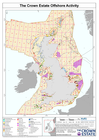
    The Crown Estate has significant interest in the offshore area which could potentially affect exploration and development proposals. Below is a map of Crown Estate interests applicants in the 27th Round should be aware of.


    Map of Crown Estate interest


    PDF, 1.19MB, 1 page


    This file may not be suitable for users of assistive technology.
    Request a different format.


    If you use assistive technology and need a version of this document
    in a more accessible format please email
    correspondence@decc.gsi.gov.uk
    quoting your address, telephone number along with the title of the
    publication ("Map of Crown Estate interest").


    If you wish to understand what the significance of these interests are for a block or blocks you intend to apply for please make contact with The Crown Estates directly.


    16 New Burlington Place

    London W1S 2HX


    Tel: 0207 851 5343
    Email: oilandgasenquiries@thecrownestate.co.uk
    www.thecrownestate.co.uk


    Some areas of UK controlled waters may be designated as Special Areas of Conservation. There is a map showing these areas, and a contact point for further information, in the link below. Potential applicants are advised to take particular notice of the Special Areas of Conservation.


    • proposed offshore Special Areas of Conservation

    • information provided by MOD


    • information on levels of shipping activity


    • Statement to the House of Commons
      (PDF, 7.43KB, 1 page)

    27th round guidance


    • General
      (PDF, 395KB, 17 pages)


    • Technical
      (PDF, 135KB, 12 pages)


    • Financial
      (PDF, 222KB, 9 pages)


    • Environmental
      (PDF, 109KB, 5 pages)

    Contacts


    First point of contact on 27th seaward round awards
    Jen Brzozowska
    tel: 0300 068 6030
    email: jen.brzozowska@decc.gsi.gov.uk


    Alternate contact
    Ricki Kiff
    tel: 0300 068 6042
    email: ricki.kiff@decc.gsi.gov.uk


    Technical contact
    UK Oil Portal support line: 0300 068 5793
    email: ukop@decc.gsi.gov.uk


    14th licence round


    DECC have published for consultation an Environmental Report on our proposals for further onshore oil and gas licensing in areas of Great Britain. This is a necessary part of a process of strategic environmental assessment (SEA).


    You can view the consultation document here: https://econsultation.decc.gov.uk/decc-policy/consultation-env-report-further-oil-gas-licensing/


    The consultation will be open until 28 March 2014.


    Once the consultation responses have been taken into account the Government will issue a “Post-Adoption Statement” which will summarise how it intends to proceed in relation to further onshore licensing.


    Contact: ogsea@decc.gsi.gov.uk


    Past licensing rounds


    Round
    Year
    Blocks offered
    Blocks applied for
    Blocks awarded
    Appns
    Licences
    Licence numbers
    Licence terms (years)(f)
    1
    1964
    960
    394
    348
    31
    53
    P001-P053
    6+40
    2
    1965
    1102
    127
    127
    21
    37
    P054-P090
    6+40
    3
    1970
    157
    117
    106
    34
    37
    P091-P127
    6+40
    4(a)
    1971-2
    436
    286
    282
    259
    118
    P128-P245
    6+40
    5
    1976-7
    71
    51
    44
    53
    28
    P259-P286
    4+3+30
    6
    1978-9
    46
    46
    42
    55
    26
    P297-P322
    4+3+30
    7
    1980-1
    395
    97
    90
    125
    91
    P325-P415
    6+30
    8(a)
    1982-3
    184
    84
    70
    60
    55
    P417-P471
    6+30
    9(a)
    1984-5
    195
    120
    93
    149
    89
    P477-P565
    6+30
    10
    1986-7
    127
    61
    51
    75
    51
    P566-P616
    6+30
    11
    1988-9
    212
    115
    115
    125
    105
    P617-P721
    6+12+18
    12
    1990-1
    161
    116
    107
    115
    74
    P722-P795
    6+12+18
    13(b)
    1990-1
    117
    66
    66
    13
    6
    P796-P801
    9+15+24
    14
    1992-3
    484
    128
    110
    97
    79
    P803-P881
    6+12+18
    15
    1994
    81
    34
    29
    25
    20
    P882-P901
    6+12+18
    16
    1994-5
    164
    82
    79
    61
    45
    P902-P946
    6+12+18
    17
    1996-7
    275
    127
    114
    32
    25
    P948-P972
    3+6+15+24
    18
    1998
    602
    82
    78
    43
    47
    P975-P1021
    6+12+18
    19
    2000-1
    44
    12
    12
    13
    8
    P1023-P1030
    6+12+18
    20
    2002
    289
    36
    36
    29
    25
    P1039-P1063
    4+4+18
    21
    2003
    611
    211
    138
    70
    89
    P1064-P1152
    4+4+18
    22
    2004
    1039
    164
    162
    76
    96
    P1159-P1253
    4+4+18(e) 2+4+6+18(d)
    23
    2005
    1329
    274
    259
    135
    151
    P1254-P1404
    4+4+18(e) 2+4+6+18(d)
    24
    2007
    1411
    255
    246
    147
    150
    P1406-P1555
    4+4+18(e) 2+4+6+18(d)
    25
    2009
    2297
    279
    303
    193
    185
    P1556-P1740
    4+4+18(e) 6+6+18(d)
    26
    2010
    2818
    356
    378
    187
    190
    P1741-P1928
    4+4+18(e) 6+6+18(d)
    27
    2012
    2788
    418
    xx
    224
    xx
    xx
    4+4+18(e) 6+6+18(d)

    Licences issued other than in formal licensing rounds, including Segregation Licences and Out-of-Round Licences, are not included here.


    One Licence number (P476) was allocated but not used.


    Since the 11th Round, licences have continued into final term only if development had already approved or imminent.


    A single application may cover separated areas, leading to more than one licence, which is why licences awarded may outnumber applications.


    ‘Blocks' includes parts of blocks.


    Table footnotes


    (a) Five blocks offered in sealed-bid auction; the rest in standard way
    (b) Frontier round
    (c) One third relinquishment if two or more wells drilled; two thirds if only one well drilled; all if no wells drilled
    (d) Frontier licences
    (e) Traditional and/or Promote licences
    (f) According to original terms of licences; subject therefore to subsequent circumstances and amendments
    (x) Figures not yet available


    Acreage offered


    List of blocks offered in each round


    MS Excel Spreadsheet, 591KB


    This file may not be suitable for users of assistive technology.
    Request a different format.


    If you use assistive technology and need a version of this document
    in a more accessible format please email
    correspondence@decc.gsi.gov.uk
    quoting your address, telephone number along with the title of the
    publication ("List of blocks offered in each round").


    Note: We have tried to make the list as accurate as possible but the information seeks to cover several decades and we cannot guarantee total accuracy. Also, precise designations of acreage may be ambiguous when comparing different dates (for instance, 14/28b in 1990 may not have been the same area as it was in 1980; and it may have been offered earlier still as part of 14/28).


    Company contacts for previous rounds


    • 25th round
      (MS Word Document, 138KB)


    • 24th round
      (MS Excel Spreadsheet, 20.5KB)


    • 23rd round
      (MS Word Document, 50.5KB)


    • 20th round
      (MS Word Document, 55.5KB)


    • Environmental Report
      (PDF, 1.67MB, 119 pages)


    • Appendices 1, 2 and 3
      (PDF, 566KB, 72 pages)

    Information about the following past licensing rounds is available on the National Archives:


    • Out-of-round offer on Seaward Block 103/1 - closed 17 November 2010


    • 26th offshore licensing round - closed 28 April 2010


    • 25th offshore licensing round - closed 22 May 2008


    • 13th onshore licensing round - closed 6 February 2008


    • 24th offshore licensing round - closed 16 June 2006


    • 23rd offshore licensing round - closed 9 June 2005


    • 22nd offshore and 12th onshore licensing rounds - closed 9 June 2004


    • 21st offshore and 11th onshore licensing rounds - closed 31 July 2003


    • 10th onshore licensing round - closed 1 April 2001

    Detailed guide: Oil and gas: field data

    By HM Government

    Updated: Oil and gas: Field approvals and start-ups in 2013 - (updated)

    Overview


    There are vast amounts of data available that relate to UK oil and gas fields, including historical and current production figures, production projections, charts indicating UK Continental Shelf (UKCS) income and expenditure, and information releases on oil discharges.


    Gas received at terminals


    • Digest of United Kingdom Energy Statistics Table F.2: Gas production

    Field details


    • Field list – a tool to find information about all UKCS fields


    • DECC field partners and the percentage of their holding - Text

    • DECC field partners and the percentage of their holding - Excel

    Total oil production: 1975 to 2012


    Oil production since 1975


    MS Excel Spreadsheet, 82KB


    This file may not be suitable for users of assistive technology.
    Request a different format.


    If you use assistive technology and need a version of this document
    in a more accessible format please email
    correspondence@decc.gsi.gov.uk
    quoting your address, telephone number along with the title of the
    publication ("Oil production since 1975").


    Total gas production: 1991 to 2012


    Gross gas production since 1991


    MS Excel Spreadsheet, 132KB


    This file may not be suitable for users of assistive technology.
    Request a different format.


    If you use assistive technology and need a version of this document
    in a more accessible format please email
    correspondence@decc.gsi.gov.uk
    quoting your address, telephone number along with the title of the
    publication ("Gross gas production since 1991").


    Flaring - by fields


    Gas flaring at oil terminals and producing offshore oilfields


    MS Excel Spreadsheet, 46.5KB


    This file may not be suitable for users of assistive technology.
    Request a different format.


    If you use assistive technology and need a version of this document
    in a more accessible format please email
    correspondence@decc.gsi.gov.uk
    quoting your address, telephone number along with the title of the
    publication ("Gas flaring at oil terminals and producing offshore oilfields").


    Oil received at terminals


    Digest of United Kingdom Energy Statistics Table F.1: Crude oil and natural gas liquids production


    Production projections


    Production projections


    PDF, 135KB, 4 pages


    This file may not be suitable for users of assistive technology.
    Request a different format.


    If you use assistive technology and need a version of this document
    in a more accessible format please email
    correspondence@decc.gsi.gov.uk
    quoting your address, telephone number along with the title of the
    publication ("Production projections").


    Production (and demand) projections


    MS Excel Spreadsheet, 276KB


    This file may not be suitable for users of assistive technology.
    Request a different format.


    If you use assistive technology and need a version of this document
    in a more accessible format please email
    correspondence@decc.gsi.gov.uk
    quoting your address, telephone number along with the title of the
    publication ("Production (and demand) projections").


    UK production data


    This is the gateway to the release of UK production data.


    • graphical format with a rolling 12-month dataset (HTML format)


    • graphical format with a rolling 12-month dataset (Excel format)


    Tabulated versions


    The following reports contain data as a rolling 12-month dataset:


    • Production in volume units (liquids in cubic metres, gas in Ksm3) – PDF


    • Production in volume units (liquids in cubic metres, gas in Ksm3) – Excel


    • Production in mass units (both liquids and gas in tonnes) – PDF


    • Production in mass units (both liquids and gas in tonnes) – Excel


    • Production in oil field units (liquids in barrels, gas in MMscf) – PDF


    • Production in oil field units (liquids in barrels, gas in MMscf) – Excel


    Historical production data


    • complete production history for oil fields (from 1975) and gas fields (from 1995)

    • well data release index page – links to all well production and injection data (up to 1999)

    Oil and gas wells


    Oil fields


    Offshore
    Onshore
    Oil fields by well
    Onshore oil fields by well
    Well oil production by year
    Well oil production by year
    Well gas production by year
    Well gas production by year
    Well water production by year
    Well water production by year
    Well injection by year
    Well injection by year

    Gas fields


    Offshore
    Onshore
    Offshore gas fields by well
    Onshore gas fields by well
    Well dry gas production by year
    Well dry gas production by year
    Well condensate production by year
    Well condensate production by year
    Well water production by year
    Well water production by year

    UK oil and gas reserves


    DECC aggregation of UK reserves and resources as at the end of 2012 is based on data collected from operators during February and March 2013.


    In total, 748 fields and potential developments or past discoveries – both offshore and onshore – were reviewed.


    Information about the data


    • analysis in the oil and gas tables is focused on remaining reserves instead of estimated ultimate recovery.

    • the UK reserves tables are presented in metric units but Appendix 1 shows field unit versions of these tables.

    • the overall summary page presents tabular figures for discovered resources only, and offers an explanatory paragraph that takes account of the estimates for undiscovered resources to arrive at a best estimate of remaining recoverable UKCS hydrocarbon resources.

    • the summary table is presented in billion barrels of oil equivalent (boe) to allow comparison of oil and gas data.

    • Appendix 2 shows historic UK oil and gas reserves and production figures and is the data used to generate the oil and gas reserves v time charts

    DECC aggregation of UK reserves and resources


    UK oil reserves and estimated ultimate recovery 2013


    PDF, 131KB, 3 pages


    This file may not be suitable for users of assistive technology.
    Request a different format.


    If you use assistive technology and need a version of this document
    in a more accessible format please email
    correspondence@decc.gsi.gov.uk
    quoting your address, telephone number along with the title of the
    publication ("UK oil reserves and estimated ultimate recovery 2013").


    UK gas reserves and estimated ultimate recovery 2013


    PDF, 182KB, 3 pages


    This file may not be suitable for users of assistive technology.
    Request a different format.


    If you use assistive technology and need a version of this document
    in a more accessible format please email
    correspondence@decc.gsi.gov.uk
    quoting your address, telephone number along with the title of the
    publication ("UK gas reserves and estimated ultimate recovery 2013").


    Estimates of UK potential additional resources 2013


    PDF, 105KB, 2 pages


    This file may not be suitable for users of assistive technology.
    Request a different format.


    If you use assistive technology and need a version of this document
    in a more accessible format please email
    correspondence@decc.gsi.gov.uk
    quoting your address, telephone number along with the title of the
    publication ("Estimates of UK potential additional resources 2013").


    Pie charts showing potential for UK reserves growth 2013


    PDF, 296KB, 1 page


    This file may not be suitable for users of assistive technology.
    Request a different format.


    If you use assistive technology and need a version of this document
    in a more accessible format please email
    correspondence@decc.gsi.gov.uk
    quoting your address, telephone number along with the title of the
    publication ("Pie charts showing potential for UK reserves growth 2013").


    Estimates of UK undiscovered resources 2013


    PDF, 189KB, 3 pages


    This file may not be suitable for users of assistive technology.
    Request a different format.


    If you use assistive technology and need a version of this document
    in a more accessible format please email
    correspondence@decc.gsi.gov.uk
    quoting your address, telephone number along with the title of the
    publication ("Estimates of UK undiscovered resources 2013").


    Summary table: ranges of UK hydrocarbon resources


    PDF, 175KB, 2 pages


    This file may not be suitable for users of assistive technology.
    Request a different format.


    If you use assistive technology and need a version of this document
    in a more accessible format please email
    correspondence@decc.gsi.gov.uk
    quoting your address, telephone number along with the title of the
    publication ("Summary table: ranges of UK hydrocarbon resources").


    Appendix 1: field unit version of UK reserves tables


    PDF, 106KB, 2 pages


    This file may not be suitable for users of assistive technology.
    Request a different format.


    If you use assistive technology and need a version of this document
    in a more accessible format please email
    correspondence@decc.gsi.gov.uk
    quoting your address, telephone number along with the title of the
    publication ("Appendix 1: field unit version of UK reserves tables").


    Appendix 2 – Historic UK Oil and Gas Reserves and Production 2013


    PDF, 53.3KB, 1 page


    This file may not be suitable for users of assistive technology.
    Request a different format.


    If you use assistive technology and need a version of this document
    in a more accessible format please email
    correspondence@decc.gsi.gov.uk
    quoting your address, telephone number along with the title of the
    publication ("Appendix 2 – Historic UK Oil and Gas Reserves and Production 2013").


    Terms


    Term
    Definition
    Estimated ultimate recovery
    Total recovery from a field, i.e. reserves plus past production
    Reserves
    Discovered, remaining reserves that are recoverable and commercial. Can be proven, probable or possible depending on confidence level
    Potential additional resources
    Discovered resouces that are not currently technically or commercially producible
    Undiscovered resources
    Undiscovered potentially recoverable resources in mapped leads

    Reserves are categorised as ‘proven', ‘probable' or ‘possible', based on confidence levels, as follows:


    Reserves
    Description
    Proven
    Reserves that on the available evidence, are virtually certain to be technically and commercially producible, i.e. have a better than 90% chance of being produced
    Probable
    Reserves that are not yet proven, but which are estimated to have a better than 50% chance of being technically and commercially producible
    Possible
    Reserves that at present cannot be regarded as probable, but which are estimated to have a significant – but less than 50% – chance of being technically and commercially producible

    This data was published in August 2013 and due to be updated in September 2014.


    UKCS income and expenditure


    The tables below outline income and expenditure related to exploration, development and operating activities on the UK Continental Shelf:


    Income from and expenditure on UKCS exploration, development and operating activities: annually 1970-2012


    PDF, 148KB, 1 page


    This file may not be suitable for users of assistive technology.
    Request a different format.


    If you use assistive technology and need a version of this document
    in a more accessible format please email
    correspondence@decc.gsi.gov.uk
    quoting your address, telephone number along with the title of the
    publication ("Income from and expenditure on UKCS exploration, development and operating activities: annually 1970-2012").


    Field Approvals


    The tables below list recent oil and gas Field Development Plans Approvals and Field Development Plan Addenda Approvals by DECC in 2012 and 2013 to date.
    A full list of offshore field approvals since 1976 is also available together with charts showing the number of new field development plan approvals and field development plan addenda approvals by year and the capex spend committed for these approvals by year.


  • Field Development Plan Approvals in 2013 to date
    (PDF, 24.7KB, 2 pages)


  • Field Development Plan Approvals in 2012
    (PDF, 22.5KB, 1 page)


  • Full List of Offshore Field Approvals
    (MS Excel Spreadsheet, 83.7KB)


  • Chart showing Number of Field Development Plan Approvals By Year
    (PDF, 95.3KB, 1 page)


  • Chart showing Number of Field Development Plan Addenda Approvals By Year
    (PDF, 118KB, 1 page)


  • Chart Showing Capex Spend Committed for Field and FDP Addenda Approvals By Year
    (PDF, 176KB, 1 page)

  • Field Start-Ups


    The tables below list recent oil and gas field start-ups in 2012 and 2013 to date.


    A full list of offshore fields in production is also available.


  • Field Start-Ups in 2013 to date
    (PDF, 12.6KB, 1 page)


  • Field Start-Ups in 2012
    (PDF, 11.1KB, 1 page)


  • Full List of Offshore Fields in Production
    (MS Excel Spreadsheet, 29.3KB)

  • Oil discharged with produced water


    A mixture of oil, water and gas is produced from reservoirs and these components are usually separated in the production train. The oil and gas is exported to shore while the produced water is disposed of. Produced water can be disposed of in a number of ways, however it is most commonly discharged to sea. The produced water will be contaminated with oil and is therefore treated to remove the majority of oil before being discharged to sea – although small volumes remain.


    Legislation


    Between 1991 and 2005, the discharge of oil-contaminated produced water from offshore installations was permitted by an exemption granted under the Prevention of Oil Pollution Act 1971 (POPA). The oil content can not exceed 40 parts per million as a monthly average.


    The Offshore Petroleum Activities (Oil Pollution Prevention and Control) Regulations 2005 (OPPC) came into effect on 20 August 2005, replacing POPA. Under OPPC, installations are granted a permit for activities discharging oil to sea.


    Since 1 January 2006, the oil in produced water must not exceed 30 milligrams per litre as a monthly flow weighted average.


    In 2001 the OSPAR (Oslo and Paris) Convention for the Protection of the Marine Environment of the North-East Atlantic – to which the UK is a contracting party – adopted Recommendation 2001/1. The recommendation set a goal that “each Contracting Party should ensure that the total quantity of oil in produced water discharged into the sea in the year 2006 from all offshore installations under its jurisdiction has been reduced by a minimum of 15% compared to the equivalent discharge in the year 2000 for all offshore installations under its jurisdiction at that time”.


    The UK oil and gas industry implemented improvements in produced water management, which resulted in the UK meeting and exceeding the 15% reduction set under OSPAR Recommendation 2001/1.


    Produced water discharges containing oil (2006-12)


    The following table details instances of oil-contaminated produced water discharges between 2006 and 2012.


    2006
    2007
    2008
    2009
    2010
    2011
    2012
    No of installations discharging oil in produced water
    105
    101
    96
    99
    95
    94
    94
    Total produced water discharged (million m3)
    219
    203
    198
    197
    197
    175
    154
    Total dispersed oil in produced water discharged (tonnes)
    4356
    2960
    3160
    2901
    3008
    2508
    2248
    Oil content (mg/l)
    19.9
    14.6
    15.99
    14.75
    15.24
    14.34
    14.6
    Number of installations re-injecting oil in produced water
    20
    23
    24
    26
    28
    28
    28
    Produced water re-injected (million m3)
    30.7
    40.5
    39.6
    40.4
    33
    38.3
    44.94

    PPRS 2000 manual


    Manual on National Archive


    Contacts


    Digest of United Kingdom Energy Statistics Table F.2: Gas production, Gross gas production since 1991 and Digest of United Kingdom Energy Statistics Table F.1: Crude oil and natural gas liquids production


    Clive Evans
    Telephone: +44 (0) 300 068 5040


    Field List


    Derek Woolley
    Telephone: +44 (0) 300 068 5751


    DECC field partners and the percentage of their holding


    Marcelle Wynter
    Telephone: +44 (0) 300 068 66057


    UK production data, Oil production since 1975 and Gas flaring at oil terminals and producing offshore oilfields


    Phil Harrison
    Telephone: +44 (0) 300 068 6036


    Oil discharged with produced water


    Jason Lomas
    Telephone +44 (0) 1224 254110


    UKCS income and expenditure, Production projections and Production (and demand) projections


    Mike Earp
    tel: 0300 068 5784


    UK oil and gas reserves


    John Webber
    Telephone: +44 (0) 1224 254069


    or


    Joy Gray
    Telephone: +44 (0) 300 068 6034


    Field Approvals and Field Start-ups


    John Webber
    Telephone: +44 (0) 1224 254069

    Detailed guide: Oil and gas: offshore maps and GIS shapefiles

    By HM Government

    Updated: Oil and gas: various offshore maps and shapefiles - (updated)

    Maps


    You can access a digital map of the UK Continental Shelf (UKCS) oil and gas activity by individual quadrant, showing the licensed areas, and below it pop-up detailed maps of each of the quadrants that contain licensed areas (updated 07 January 2014).


    Other maps of the UKCS


    UKCS infrastructure wallmap showing oil and gas activity (updated 07 January 2014)


    PDF, 2.83MB, 1 page


    This file may not be suitable for users of assistive technology.
    Request a different format.


    If you use assistive technology and need a version of this document
    in a more accessible format please email
    correspondence@decc.gsi.gov.uk
    quoting your address, telephone number along with the title of the
    publication ("UKCS infrastructure wallmap showing oil and gas activity (updated 07 January 2014) ").


    • UKCS designations
      (PDF, 839KB, 1 page)


    • UKCS geological basins
      (PDF, 1.33MB, 1 page)

    In place Crown Estate Leases, Agreements for Lease and Search Areas (overlaying UKCS Petroleum Licensing Blocks)


    This map is designed to assist petroleum licence holders to identify any area conflicts that their petroleum licences have with other users of the sea that have been granted rights by The Crown Estate.


    Petroleum licence holders should identify any blocks where they hold a licence to check whether there may be a potential area conflict with a The Crown Estate rights holder. This could involve a physical overlap between a petroleum licence and The Crown Estate lease, etc or potential conflict as the areas are adjoining or near to each other (e.g. a helicopter zone may overlap with The Crown Estate lease, etc).


    Petroleum licence holders are strongly advised to contact the other right holder(s) at the earliest opportunity to discuss and resolve any potential conflicts.


    Further details are available on The Crown Estate web


    Petroleum licence holders can contact The Crown Estate at oilandgasenquiries@thecrownestate.co.uk or on 020 7851 5343with general or specific questions.


    TCE Leases and OG Licences


    PDF, 1.19MB, 1 page


    This file may not be suitable for users of assistive technology.
    Request a different format.


    If you use assistive technology and need a version of this document
    in a more accessible format please email
    correspondence@decc.gsi.gov.uk
    quoting your address, telephone number along with the title of the
    publication ("TCE Leases and OG Licences").


    27th round of offshore licensing


    • 27th round Blocks applied for
      (ZIP, 122KB)


    • 27th round Provisional Awards (updated 1st June 2013)
      (ZIP, 21.7KB)


    • 27th round Blocks available for licensing
      (ZIP, 181KB)


    • Blocks relinquished (in whole or part) since the start of the 27th round process (updated 07 January 2014)
      (ZIP, 49.3KB)


    • Hydrocarbon fields
      (ZIP, 1.1MB)


    • Current licensing position (updated 07 January 2014)
      (PDF, 1.39MB, 1 page)

    27th round of offshore licensing - Second Tranche


    • 27th round Provisional Awards - (added 29th November 2013)
      (ZIP, 58.6KB)

    Offshore GIS shapefiles


    The shapefiles below are constructed by connecting GCS coordinates with a straight line rather than a geodetic arc (takes into account the curvature of the earth). They are therefore not suitable for defining legal boundaries or measuring areas.


    Shapefiles
    What it covers
    Last updated
    Median line
    extent of the UKCS - intended as a guide to offshore licensing. Does not contain definitive legal boundaries
    03 February 2012
    Hydrocarbon fields
    oil, gas and condensate fields on the UKCS – indicates hydrocarbons only, not an accurate reflection of reservoir boundaries
    07 January 2014
    Coastline
    low-resolution coastline of mainland Britain
    -
    Quadrants
    1 degree x 1 degree grid of the UKCS

    -
    Licensed blocks
    grid of blocks and part blocks displaying licensed areas – intended as a guide, does not contain definitive legal boundaries. Download sub-area blocks shapefile or visit Licenses page of site for further details on operators
    07 January 2014
    Field determinations
    taxation boundary that determines a hydrocarbon field
    07 January 2014
    Wells
    surface locations of all UK onshore and offshore wells
    07 January 2014
    Strategic Environmental Assessment areas
    areas considered for environmental protection and suitable development
    -
    Significant discoveries
    discoveries identified by DECC as “significant” in terms of flow rate. Does not indicate commercial potential, but identifies those with an approved or in-production field development plan
    07 January 2014
    Renewable Energy Zones
    boundary line for application of English and Scottish civil and criminal law to offshore renewable energy installations
    16 September 2009
    Sub-area blocks
    grid of blocks and part blocks displaying operator and equity details – intended as a guide, does not contain definitive legal boundaries
    07 January 2014
    Licensed and unlicensed blocks
    grid of all licensed and unlicensed blocks - intended as a guide, does not contain definitive legal boundaries
    07 January 2014
    Fallow Blocks and Discoveries
    most recent listing of fallow blocks and discoveries
    08 April 2013
    Geological Basins
    Major & Sub Geological Basins
    31 July 2013
    Pipelines
    not maintained by DECC – see UKDEALfor shapefile
    -
    Wind Farm areas
    not maintained by DECC – see Crown Estatefor shapefile
    -

    Disclaimer


    This data is supplied on a best effort basis only, utilising available information as provided by the original operators. While every effort is made to ensure the information is correct and up-to-date, the Department does not accept any liability for any direct, indirect or consequential loss or damage of any nature, however caused, which may be sustained as a result of reliance upon such information.


    If any errors are found or if you have any comments or other queries please contact:


    Jerry Carnell
    GIS Manager
    Telephone: 0300 068 6031
    Email: jerry.carnell@decc.gsi.gov.uk

    Detailed guide: Oil and gas: licence relinquishments

    By HM Government

    Updated: Oil and gas: Relinquishment reports - (updated)

    Overview


    There are 2 ways in which a licensee can give up acreage:


    • ‘surrender' part of the licensed area while the licence continues over the remaining area.

    • ‘determine' the entire licence.

    The licensee can do either one at any time, subject to a few conditions.


    DECC operates a Portal-based procedure for processing surrenders and determinations of offshore licences. Further guidance is available here


    At the time of writing (January 2013), the Portal only handles offshore licences; surrenders and determinations of landward licences continue to be handled by email. We are working to integrate them into the Portal during 2013.


    To surrender acreage or determine a licence, complete a licence determination form (below) for each licence and email them to licence.relinquishments@decc.gsi.gov.uk


    Licence determination form


    MS Word Document, 42.5KB


    This file may not be suitable for users of assistive technology.
    Request a different format.


    If you use assistive technology and need a version of this document
    in a more accessible format please email
    correspondence@decc.gsi.gov.uk
    quoting your address, telephone number along with the title of the
    publication ("Licence determination form").


    Restrictions


    There are 2 restrictions to the licensee's right to surrender or determine.


  • ‘Non-standard' surrenders – irregular shapes defined by very short lines, or surrenders that leave a very small licensed area. The exact definition is in the clause titled ‘Areas surrendered' within each licence (see the 2004 Model Clauses Regulations for example). Non-standard determinations require Department of Energy & Climate Change (DECC) assent.

  • A licensee may not make a surrender or determination if it would prevent fulfilment of a licence obligation, eg where a licence carries a work programme with a Firm Well Commitment, the licensee cannot determine the licence without drilling the well (or surrender acreage if it includes a location specified in the commitment as the place where the well is to be drilled).

  • Notice periods


    DECC requires recent Seaward Production Licences (P1155 and later) to provide 1 month's notice before determination/surrender. Be sure to submit the form in good time and specify an effective date at least 1 month in advance.


    Older Seaward Production Licences specify 6 months' notice. DECC will often accept just one month's notice but we reserve the right to insist on the full 6 months – especially where there is a need to plug and seal wells. Note: this may affect the licensee's liability for rentals at the next licence anniversary, therefore DECC strongly recommends licensees ensure there are no producing or suspended wells on any acreage before they seek to surrender/relinquish it.


    Company loss of licence involvement


    Even though a surrender may occasionally leave a company without beneficial interest under the licence, the surrender does not remove that company from the licence. It will remain a party to the licence unless and until it withdraws by assigning its rights to the remaining companies. An assignment is often made effective on the same date as the surrender, but it does not need to be. Note: all assignments require the Secretary of State's permission; enter the name of the departing company at Q9 on the form to apply.


    Relinquishment reports


    DECC requires a relinquishment report at the time of determination for all Seaward licences from P1064 upwards. This requirement is conferred by the Model Clauses and invoked by a paragraph within the covering letter that accompanied each new licence issued in the 21st and later rounds. PILOT and DECC also agreed the requirement of a relinquishment reports with submissions from older licences for a full licence relinquishment or relinquishment of non-contiguous blocks in multiblock licences.


    The reports must comply with the guidelines (below) and be submitted within 3 months of the request.


    Guidelines for writing relinquishment reports


    MS Word Document, 19.5KB


    This file may not be suitable for users of assistive technology.
    Request a different format.


    If you use assistive technology and need a version of this document
    in a more accessible format please email
    correspondence@decc.gsi.gov.uk
    quoting your address, telephone number along with the title of the
    publication ("Guidelines for writing relinquishment reports ").


    The latest release in January 2014 adds 37 Licence Relinquishment Reports to the 403 already published. The first release in February 2008 consisted of 45 Licence Relinquishment Reports with further reports added every year. A further release is expected later in 2014.


    N.B. The reports may take a while to load


    Relinquishment Reports


    Neither the Secretary of State nor the Department of Energy and Climate Change accept responsibility for any of the information published above nor do they warrant the accuracy of any data supplied by the Secretary of State.


    Address all queries about relinquishment reports to Jen Brzozowska at jen.brzozowska@decc.gsi.gov.uk or phone 0300 068 6030


    Data retention obligations and the NHDA


    DECC takes seriously the obligation, borne jointly and severally by all licensees in the licence group at the time of determination, to hold licence data in perpetuity. DECC will scrutinise long-term data management strategies at licence determination and reminds licensees the only way of gaining relief from this obligation is to place licence data in the National Hydrocarbons Data Archive (NHDA) – DECC's preferred option for storage.


    Visit the NHDA website for more information or contact:


    • Phil Harrison (DECC) – phil.harrison@decc.gsi.gov.uk

    • Colin Graham (BGS) – ccg@bgs.ac.uk

    Completing the form


    DECC will assume the form has been submitted in accordance with the wishes of the entire licence group under the terms of the joint operating agreement (JOA) or similar agreement. DECC cannot accept responsibility for ensuring compliance with the terms of a JOA, but would like to know when a dissenting party has been outvoted (see Q8). Please email applications where possible, but postal applications can be sent to:


    Licensing Exploration and Developments (licence determinations)

    Department of Energy and Climate Change

    3 Whitehall Place

    London

    SW1A 2AW


    Part 1: contact details


    Include details of the person we should approach for further information, and to whom we should reply. Enter a return postal address at box 4 if you want a written response.


    Part 2: nature of determination/surrender


    • enter the subject licence and the block(s). Also attach (or enclose) a map showing the acreage before the determination/surrender, indicating the position and status of any approved fields and wells within the licensed area.

    • for a surrender, indicate clearly which acreage is to be retained and which surrendered.

    • at Q6 indicate if you are determining the full licence. If you are, you can skip part 3.

    Part 3: area to be surrendered


    Do not complete this part if you are determining a full licence.


    • enter the grid coordinates that define the area to be surrendered (not the area to be retained). Use the suitable systems to define the coordinates: ED50 datum for offshore licences; National Grid datum for onshore licences. Show the location of all wells and fields within the currently licensed area.

    • specify any sub-area that lies wholly within the area to be surrendered, which will disappear as a result of the surrender.

    • name any company left without beneficial interest in the licence that will seek the Secretary of State approval for an assignment to withdraw.

    Part 4: questions


    • name here any party to the licence that objects to the determination/surrender – even if it is not able to block it.

    • note any incomplete element of the initial term work programme (initial term licences only).

    • list each well on acreage that will become unlicensed, including details of its status (producing, suspended, abandoned, etc.).

    • specify any fallow acreage to be surrendered/determined.

    • enter the effective date of the surrender/determination, bearing in mind the strictures on notice periods (above).

    • add all other details you think we might need to know.

    Publication of relinquishment/surrender reports


    Through PILOT, the Government and oil and gas industry have been discussing ways to increase exploration activity. They decided potential future licensees could benefit from the dissemination of geotechnical understanding on acreage that has been worked and relinquished. PILOT decided the best way to achieve this would be through publication of relinquishment reports, which are prepared by relinquishing licensees and submitted to DECC.


    Relinquishment reports have been required on all licences since the 21st Round, as part of the licence issue covering letter. Promote licensees are required to provide a report at the two-year break point if the licence is not continuing. However the initiative to publish the reports, which was supported by Oil & Gas UK and OGIA, now also require reports where a whole licence or non-contiguous blocks in multi-block licences (of any vintage) are relinquished.


    Subject to third-party data confidentiality checks, which are a responsibility of the operator producing the report, relinquishment reports will be published either on receipt by DECC or after the next licence round if extended confidentiality is formally requested at the time of submission.


    DECC relies on the operator to confirm all necessary permissions have been obtained from any person, group, or company that may own the intellectual priority (copyright) within any material to be published. Clearance for publication must cover items such as:


    • seismic lines

    • reprocessed seismic data

    • extracts from commercial reports / maps / group-funded reports

    • maps

    • sections

    • well data

    Contact information


    Joy Gray
    Senior Geoscientist – Promote UKCS
    joy.gray@decc.gsi.gov.uk
    0300 068 6034